A Few Legends Return...

I had a quick think about a post to put up on a day where I couldn't face more geometry study and my head was all sick feeling and whatnot, so I decided to do this. There have been more than a handful of Argentine footballers who have come to the bright lights and slick surfaces of Europe's top teams, and then headed back home when their star began to set. Recently, this has started happening in Brazil too, and if I have a spare few hours again soon I might throw something together on that. But for today we're just looking at Argentina, and some of the legends who have gone and come back to give the fans a goodbye in their home country.

  1. Juan Sebastian Verón
    One of the absolute greats, Juan Sebe Verón at Estudiantes de la Plata.
    Verón began his career with Estudiantes in 1993, and helped them to return to Argentina's top flight in 1995. He comes from a footballing dynasty of sorts, in which his father Juan Ramón Verón and his uncle, Pedro Verde had also been professional footballers1. Verón had a short spell at Boca in a team where he played with Maradona, but was fairly quickly noticed as a huge talent, and taken to Sampdoria by a man who has been much maligned in the English press, Sven-Göran Eriksson. Here he began to really dominate games, and moved to Parma and eventually to Lazio. It was from here that Manchester United bought him, and his time in England was certainly not a highlight for his career. His talent was undoubted, and the ability was there, but certainly it could be said his career stalled somewhat at this point. A move to Chlesea came afterwards, where he made very few appearances, and ended up on loan to Internazionale and eventually returned to Estudiantes. 2009 was to see the realisation of a dream for Verón, as he was able to lead by example, as captain, and guided his team to the Copa Libertadores final against Cruzeiro of Brazil. All round, he made a pretty successful return to his boyhood club, and has stated in the past that he may wish to run for the position of president of Estudiantes in the future.
  2. Juan Román Riquelme

    Riquelme is probably Ray Hudson's favourite player of all time (and if you don't know Hudson, look here: http://www.youtube.com/watch?v=gS6Np-g_h5w He thinks Argentina are “merciless, like Kathy Hudson with the sledgehammer in that movie...”). He began his career at Argentinos Juniors, and was snapped up by Boca, the club he had supported as a boy, in 1995. He played in front of the crowd at La Bombonera for several very successful years, winning a few titles including the much coveted Copa Libertadores. He moved to Barcelona, but was never in favour with Loius Van Gaal (a man who is not without his enemies in football himself), and got very little game time. It was at Villareal, where he moved after his ultimately unsuccessful period at Barça, where his talent shone. In a four year period with the Yellow Submarine, Riquelme helped the team to the semi-finals of the Champions League, a huge achievement for a club with such a small base to build from. The situation regarding his leaving Villareal and going back to Boca was a bit of a murky one, and seemed to involve some tension and falling outs, although his eventual return was a welcome homecoming which saw more success for both Boca and Riquelme, including a good showing in the Libertadores in 2008. He has also formed part of the Boca squad which had gone 38 games unbeaten until this week, which is not a bad run all told.
  1. David Trezeguet

    Not many know that he spent his childhood in Buenos Aires, and he always been a huge River fan since he was a boy. Although he ended up playing for France, he still speaks Spanish like a an Argentine2. He was born in Normandy in France, but returned to Buenos Aires, where his talent was spotted by Los Calamares, Club Atlético Platense3. Trezeguet was more or less immediately spotted, and was taken to Monaco in 1995. He arrived shortly after the departure of Wenger, but that didn't slow him down. He gained a name as a great goal scoring talent, and it wasn't long before his talent was recognised in Italy. His spell at Juventus saw him become the club's highest leading non-Italian goalscorer, netting 138 times in his ten year spell at the Old Lady. When his time in Italy was over, he moved to Hercules in Spain, based near Alicante, most likely because his wife is from there. As a newly promoted team, it wasn't for a large payday anyway. After a year there, he moved to Abu Dhabi based Baniyas, but returned quickly to Argentina, and signed this year for River Plate, the club he had supported as a boy in Buenos Aires all those years ago. He has picked up an injury recently, but has already scored two in his first three games back at the River, who are fighting for promotion to the Primera again, after being relegated for the first time in their history last year. He joins Leo Ponzio who returns from Zaragoza to help the team through one of the most difficult periods in its history.
  2. Mauro Camoranesi

    Camoranesi is one of the many in Argentina who claim Italian citizenship: nearly 4 million still hold Italian passports in the country, and they have greatly contributed culturally to Argentine society since the early twentieth century. He was born in Tandil, in Argentina, and had a fairly nomadic start to his footballing career, moving between Argentina, Mexico and even Uruguay, briefly. His spell of real success on the field was at Cruz Azul in Mexico, where he was able to impress by scoring 20 goals for the club from his position on the wing. This brought him onto the radar screen for Verona, where he had a similar goals haul across two seasons, and was eventually signed by Juventus, playing in the same team as a fellow-non-Argentine-but-really-is-Argentine-player, the aforementioned David Trezeguet. His time with Juventus saw the match fixing scandal and the relegation of the club, but he stayed loyal throughout this period, and continued with the Italian giant, and fought for their return to Serie A. He also picked up a World Cup Winner's medal for his troubles, as he played with the Italian national team, rather than Argentina. When he finally left Juve in 2010, he spent only six months with Stuttgart making just 7 appearances, before moving back to Argentina and signing with Lanus, a team which has an image of the Falklands or Malvinas Islands on their jersey this season. He has made some headlines upon his return, but mainly for kicking Patricio Toranzo in the head, more so than his performances.
1 http://www.guardian.co.uk/sport/2003/mar/02/football.features1 “My uncle played for Sheffield United”
3 for a good explanation of this great club name, listen to Hand of Pod here: http://handofpod.wordpress.com/2012/01/31/episode-48-gay-simon-platense-and-other-silly-names/ )

On the occasion of the birthday of Jorge Luis Borges


On this day in 1899, Jorge Luis Borges, one of the greatest authors of the twentieth century, entered the world. He was a man of complicated descent: His father had English roots, which didn't sit well with the Argentine populace during the década infame and the anglophobia which gripped the nation afterwards. His mother was a Suárez and a Laprida, from the lineage of a criollo and an independence fighter who signed the Declaration of Independence at the Congress of Tucumán in 1816, which launched Argentina's independence, and alerted the world to its presence as a new nation.

Borges was to be the man who, from the library in his father's study on calle Tucumán, was to announce to the world that Argentina had arrived in a literary sense, and the Latin American authors who cite him as a hugely important influence include Gabriel García Márquez, Carlos Fuentes, Julio Cortázar, the list goes on, and is astoundingly impressive. His father's library was the place where Borges first fell in love with books, where he first read Martín Fierro and realised the potential of the gaucho figure, the One Thousand and One Arabian Nights (Alf Layla wa Layla) and became fascinated by its circular structure, similar to Hamlet. These were to become reference points in his works, which he drew upon time and time again. His summers were spent with his family in Adrogué, a city in the Greater Buenos Aires province, to escape the heat of the city. There, the Hotel Las Delicias became a symbol also, appearing in his "Tlön, Uqbar, Orbis Tertius" years later, as well as being the basis for the Hotel Triste-le-Roy in "Death and the Compass". Argentina, the land of his birth, influenced and shaped his works.

In Europe where the Borges clan moved to in 1914, a young Jorge Luis attended school in Geneva, where his name was pronounced so that he couldn't understand it, and was nudged by a classmate when he needed to give a response. Moving to Spain in 1919, Borges was beginning to formulate his desires to write, although he hadn't yet found his voice. He returned to Argentina a dedicated surrealist poet, only to shun that image. Later, the family moved back to Europe for a second time, but not before Fervor de Buenos Aires, his collection of poems, had been published in 1923, by his own hand, and distributed to those who he thought would best be able to review it. Upon his return to Argentina, the critical reaction to it was, for Borges, surprisingly mild. No one had panned it. But he still hadn't fully formulated the mixture of the Old World literary canon and the mystery and myth which the New World presented in the way he had hoped.
He worked in the National Library, he opposed Perón bitterly, which was to cost him his job at the library, and he continued to write. Essays, poems, eventually short stories. In his "Approach to Al-Mu'tasim", the extent of his imagination, guile, trickery, and mischievous attitude was seen, as he created an imaginary book and wrote about it in a pseudo-essay and hoax, which sent literati to the book shops of Buenos Aires searching for a new addition to their library which didn't exist.

Fictions (a collection which comprised Artifices and The Garden of Forking Paths) was to be Borges' breakthrough, and contains some of the best short stories in the Spanish language, or any language for that matter. The story of a new world which usurps our reality in Tlön, the story of the famous library of Babel, Funes the man who cannot forget anything, the ending of the vuelta of Martín Fierro in which the brother of the gaucho killed by the eponymous protagonist exacts his revenge, only to realise he and Fierro are the same, all of them place Borges firmly and squarely on the literary map. His location on that map was Argentina. The Aleph, his next collection, solidified his reputation, a collection which includes detective stories, stories of the infinite and the immortal, stories of the finite and the obsessive, it was all in one, the Aleph.

Borges' life continued apace from those outings, and he began to move outwards, showing that literature need not abound in the local colour of guapos and knife fights to be national. He gave lectures in the United States where, along with France, the reputation afforded him was befitting of the stature of the works which he produced. Affected by the blindness which had been part of his father's legacy, Borges was writing in the dark, and began to use the structure of poetry as a framework on which to hang the issues which had always preoccupied him: immortality, mirrors, myth, time, reality, folklore, a list which could not all be enumerated in the space of a blog post. He died in Geneva in 1986, having married Maria Kodama earlier that year, and no one from the Peronist party attended his funeral due to, it is claimed, certain declarations he had made about the country. The only declarations which matter are the ones he made in his literary works, the ones which claim that the literary efforts of the Argentine mind could not be limited to "algunos pobres temas locales, como si los argentinos sólo pudiéramos hablar de orillas y estancias y no del universo”. From the city of Buenos Aires, a metropolis of intertwining cultures and checkered city grids, Borges took the first step on the path to the Latin American Literary Boom which brought the world's attention to a people and a place that the West thought they had invented, but were being forced to realised existed independently of them. Who was dreaming who?


Today's Google doodle depicts Borges looking out on a Boschian world of strange architecture, which underlines Borges' incredible ability to describe spaces, something which has given his work the longevity which it still enjoys. No two readings are ever the same, where something jumps out at you which you didn't notice before. Like Fermat and his infinite descent, who Google chose to honour with a doodle recently also, Borges is a man whose work also provides an infinite number of possibilities. A fact which would please the Argentine maestro (and something which he knew, seeing as he references Fermat in Ibn-Hakkan al-Bokhari, Dead in His Labyrinth) is that an infinite descent's purpose is to prove, through contradiction that there is no possible end, because if there is infinite descent, then the smallest number must have a number smaller than it, otherwise infinite descent does not exist. A suitably Borgesian paradox.


River Plate - Historic Scenes from the Río de la Plata


In the history of Argentine football, few teams are as well known or have had as much success as River Plate, who boast that they are “el más grande” on the collar of their shirts. With 33 championship titles, it would be hard to disagree with such a statement. They have been in poor form for quite a while however, they were relegated on Sunday night after losing a playoff against Belgrano of Córdoba. Fans have reacted angrily, with some breaking the fences at last Wednesday's first leg to push and gesticulate at the players, causing the delay of the game for over twenty minutes. Others turned up at the team's hotel after the game demanding to speak to the players and coaching staff, and the board of directors themselves were attacked while trying to check into a hotel in Córdoba1, as well as rioting throughout Buenos Aires on Sunday evening. River Plate have been in the top flight of the national championship since they began, and relegation seemed almost implausible to their following. The reason for the fan's anger is the disintegration of that legacy, which reaches back to the club's founding in 1901, as long and prestigious a history as a club can hope to garner in world football, verging at times on the mythical.

It was of course, with myth that much of the histroy of the Río de la Plata region began. The basin and river are the most densely populated areas in both Uruguay and Argentina, and boast two of the world's capital cities: Montevideo and Buenos Aires. From the sixteenth century, the area attained a folkloric status as being the home to vast amounts of silver, giving it the name which it now holds, after Sebastiano Caboto was able to trade for silver trinkets with the Guaraní while he explored the basin. Eager conquistadores who heard tales of a new Eden, or mountains of pure silver and lost cities of gold saw Latin America as a place where such legends could exist, and the continent itself has juxtaposed, since its conquest, the new and the old in which the promise of a myth-turned-reality is housed. The eventual foundation of Buenos Aires in 1580 (on the second attempt), brought a real city to the “New World”, and, after the eventual unification of Argentina under Rosas, that city became the capital. By the nineteenth century, immigration rose as Europeans flocked to the great capital of Argentina, which was seen as a metropolis of such stature that only Paris was comparable. With the building of the Argentine rail network, the British influence on Argentine life began to be felt, and it is no coincidence that the games of rugby, polo, and football are popular in Argentina. The first football game took place in 1867, amongst mostly British citizens. Football went from strength to strength in Argentina, with the amateur era leading to the popularization of football, and a surge in the founding of clubs, amongst them River Plate (with their English name), in 1901.

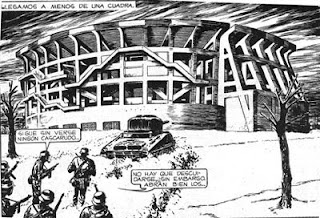
River were founded in the neighbourhood of Boca by the workers of the Wilson coalyard, who had decided to form a football team. The name was taken from the containers which were shipped in and out of the coalyard on a daily basis, and they eventually merged with La Rosales to found the club as it is known today. The early years of amateur football in Argentina were dominated by British workers in the form of Alumni, made up of students of the Buenos Aires English High School. When they disbanded in 1911, it was Racing who took up the mantle, winning seven consecutive championship titles. It wasn't until the arrival of full professionalism in the 1930s when River began to shine, and also garnered their nickname millonarios or millionaires. With the expensive signings of Carlos Peucelle and Bernabé Ferreyra, River Plate were to change the history of Argentine football. Ferreyra's fee was around £23,000 at the time, which works out at around £6-8 million in today's money2. He turned out to be worth every penny, scoring 43 goals in 34 games in the 1932 season, and finished his career with more goals scored than games played. In that same year, they finished level on top with Independiente, and won the playoff 3-0, claiming their first professional championship. In 1938, another historic moment in River's history took place, as they moved to El Monumental stadium, which has become an iconic image in Argentine culture, even appearing in the famous graphic novel by Hector Germán Oesterheld El Eternauta.
The scenes after last night's relegation were as apocalyptic for River fans as Oesterheld's vision from 1957, and the aftermath had the air of life imitating art, as can be seen in Olé's coverage of the events3.

From its inauguration on 26th of May that year, el Monumental was to be home to a constant flow of success for River. By the 1940s, River had constructed a team of renown, still remembered to this day: La Máquina. Juan Carlos Muñoz, Adolfo Pedernera, D'Alessandro, Ángel Labruna (who still sits atop the all time goalscoring charts in the Argentine league), Félix Loustau and Aristóbulo Deambrossi were some of the players who formed that historic team, famed for their passing and movement which caused defenders nightmares, and who form a large part of the mythical history of the Buenos Aires club. The title in 1942 was claimed in La Bombonera, as sweet a victory as River could ask for, coming back from two goals down to claim the title against their arch rival. 1947 was another year which stood out, with Alfredo Di Stéfano leading an attack which scored 90 goals in a mere 30 matches, and the legendary goalkeeper Amadeo Carrizo leading a defence which helped River win another title. That level of success continued into the 1950s, even with players moving to European giants and to Columbia, where a burgeoning league was able to pay high wages. River won 6 titles in that decade, as well as winning their first tricampeonato between 1955-57. in 1958, River also had 9 players in the national team's Starting XI, a record of representatives for one club.

River's success dried up shortly afterwards, and for 18 years they went without silverware, a period which, until Sunday, would have marked their lowest ebb. In 1968 they came close, but were denied by the hand of Luis Gallo of Vélez, who blocked the ball of his line with minutes remaining. River were not to win again until the 1970s, and once again Ángel Labruna was the saviour of Los Millonarios, this time, however, as coach.
The emergence of more stars in River's illustrious history was to help them to a renewed period of success under his stewardship, with Norberto “Beto” Alonso and Ulbaldo Filiol leading the team, and players such as current manager Juan José “J. J.” López and current president Daniel Pasarella coming through the youth ranks to become titulares. Between 1975-79, River won four Metropolitanos and two Nacional tournaments, including doing the double in 1975 and again in 1979.

In 1983, the signing of Enzo Francescoli began a process of rejuvination which was to bring about arguably the greatest period in the history of River. By 1985, River were champions again, losing only three games on their way to the 1985/86 league title. The return of Alonso (who was sold to Vélez after a falling out with the legendary Alfredo Di Stéfano, who had been manager until '82) and the addition of Oscar Ruggeri, amongst others, led the team to their first Copa Libertadores glory, although Francescoli had left for France before the victory in 1986. That same year, River also won the Intercontinental Cup. It would be ten years before the club won the Libertadores again in 1996, this time, however, Francescoli was present (along with other famous names such as Hernán Crespo, Ariel Ortega and Juan Pablo Sorín) to help the club regain its place as the leader on the continent. River continued to win titles into the 2000s, yet the dip in form which has led to relegation began in 2008, when River finished last in the table. Managerial instability, debt problems left by the presidency of José María Aguilar to the tune of $140 million and overall instiutional difficulties have culminated in the relegation of one of the world's most historic and famous clubs.

As Veléz winning the title was overshadowed by Martín Palermo's retirement at Boca, so Córdoba's promotion has also been left aside somewhat in the tumult of events since the game was abandoned. They were deserved winners over two legs, and eventually analysis will turn to their performances and their newly-attained top flight status. The worry for fans of Argentine football is twofold however. Firstly, the seemingly endemic fan violence in the game which reared its ugly head yesterday has seen Argentina's reputation tarnished just before they host the Copa América. It should be noted that this violence is part of the club game, and doesn't spill into the international arena. The Copa América will take place in safe environments, and will be undisturbed by scenes anything like those witnessed at El Monumental. However for the benefit of the sport at the club level, this is something which should be addressed. Secondly, the biggest game of the Argentine calendar, the meeting of two old local rivals which has taken place since 1913, will be missing: The superclásico. Without it, the league will feel somewhat more empty (as will a few people's pockets), and although many Boca fans are probably smiling at the embarrassment of their neighbours, they will certainly miss the high and the excitement of a match which pits two giants of world football against one another. The instiutional and economic problems of the club reach back beyond this season, and unless these issues are resolved, it will be difficult for River to return to the top flight quickly.