The plight of the creative black player

I regularly listen to the Americarnage podcast, and this past week they were discussing racism in American sports and the name 'Redskins' for the Washington NFL franchise. This reminded me of a previous discussion they had regarding the pigeon-holing of players in to certain positions in the NFL as a result of their skin colour, and while at first I thought this may have been a problem for American sports, in fact this is also an issue in football in Europe.

Whether it is something you have acknowledged or not, it seems increasingly difficult if not impossible to find a player who sits behind the striker or an attacking midfielder or a jinky winger who is not either white European or South American in the Premier League or La Liga. Certainly I can't think of many of the top of my head, bar Steven Pienaar.

It would be absurd to suggest that there are none, but it seems that whether it is by institutionalised design at grass roots level or a sense that still exists that the best players for those positions are Hispanic or white, somewhere along the line players form Africa or of African descent are put into different positions on the pitch where creativity is not as highly valued. Certainly, in the NFL until recently, the Hall of Fame quarterbacks were without exception white, and as the old football saying goes, perhaps their face just didn't fit. Even if those players have displayed a touch of flair or ability to pass in to good areas, that is often ignored in favour of playing them further back the pitch, in particular in defensive midfield.

Something which also pointed me towards this topic was a piece I wrote recently on Jay Jay Okocha, arguably one of the last great showmen of football (along with Ronaldinho). I say this because while Cristiano Ronaldo and Lionel Messi are clearly fantastic footballers, they're not showmen. They do tricks purely in a functional way in order to score goals, which they do by the bucket load. Okocha and Ronaldinho appear to get great joy (as does the crowd, it should be added) from the feat of pulling off the unexpected. In case you've forgotten Jay Jay, sit back and enjoy this clip.


George Weah was another hugely talented player who, while more of a striker than a creative midfielder, still showed incredible vision for a pass, went on weaving runs and mesmerised us with spectacular goals. Not that it should need to be included of course, but we all remember this all-time classic one against Verona.


Difficult to watch that without thinking of the Football Italia theme tune with James Richardson enjoying an espresso at a piazza.

Anyway, back to business. Other creative players who spring to mind are those like Finidi George, highly prized as a creative force, not as a defensive midfielder; Clarence Seedorf , who is still playing in Brazil and has shown that he is more than capable of fulfilling that role and there would be very few people who would not say that he is a player of real class.

These examples are all of midfielders who you could build a team around, who would dictate the pace of a game and produce a moment of genius that would decide it. While there are many strikers who are not white in the Premier League and other European leagues, these players are often not as skillful or creative as those cited above, perhaps because the demand (and therefore the money for smaller clubs and academies) is in producing players who are physically strong, powerful, and have enough technique to be a purely functional player in their position. Although Drogba is clearly gifted with technique and skill, and perhaps even Romelu Lukaku also, both of those players are always discussed in terms of their physical attributes first and foremost.

Michael Essien and John Obi Mikel were two of the most highly rated midfielders in African football in recent memory, and yet at Chelsea, both were put behind the midfield to shield the defence. Essien came to the Premier League with a reputation as the creative force in the midfield of Ghana's national team, but ended up being, for want of a better word, a clogger. He showed his ability and technique with a memorable goal against Barcelona on his left foot, but it was not enough to see him moved further up the field and given a bit more freedom. In fact, as his career progressed, he ended up being shoved in at right back and the odd time at centre back, simply because of his frame.


Mikel has also not produced the goods in the middle of the park for Chelsea, but also while playing out of position. It should not be glossed over that Manchester United and the London club virtually went to war over how highly rated this teenager was, and then wasted his talent by playing him in a part of the pitch that he wasn't comfortable in. Yet still, when he plays for Nigeria and is given a more advanced role, he looks like a totally different player and fans wonder why that is.

While not from Africa, Anderson was a black player who arrived to England with the tag of the 'New Ronaldinho' hanging around his neck like a millstone. It turns out that he needn't have worried about that, as he was immediately sent to defensive midfield to get through the work and break up the play. He was also sent to the gym to bulk up, and even the most casual Premier League fan will tell you that he's not exactly a vision of physical fitness.

News Photo: Portos Brazilian Anderson Oliveira celebrates his opening goal…

Perhaps, on reflection, he is not meant to carry that much muscle, perhaps he was destined not to get through defensive work where any Manchester United fan will tell you he's not really suited to playing, perhaps, indeed, his frame when he arrived allowed him to manoeuvre and turn quickly, to wriggle away from challenges and to glide around the area of the box producing smart passes and moments of excellence. Ask fans if that's the Anderson they would have preferred to see, the one whose debut season saw him play to a very high standard, and you will only get one answer.

But that is the way the game has gone. The production (and I choose that word deliberately) of young players is now big business, and you make a product to suit demand. That demand is for someone who can run for 90 or 120 minutes, make a tackle and maybe shoot the odd time.

There is the possibility that, like in Brazilian football, the money is in making players of a certain type and that has caused this shift. Years ago, before Spain arrived with their tiki taka football Brazil shifted their attentions to producing athletic players who were more physical than the opposition, and still technically solid.  Now they're laden down with midfielders who can shore up the defence, but struggle to find one creative striker, a position where they were spoiled for choice for decades.

To return to where we started out with the NFL, even the terminology in and of itself is becoming tainted, with the world "athletic" or "mobile" being used almost exclusively for black players in American football. The NFL in recent years has seen a huge sea change, where now some of the best and most versatile quarterbacks in the game are not white. Robert Griffin III proved that last season, Cam Newton had a record breaking debut year, Russell Wilson (also deemed too small to play the position) was absolutely irresistible and nearly lead the Seahwaks to the Championship game in the NFC. Is there a lesson to be learned from this?

I would argue that there is. The franchises in the NFL are slowly but surely learning that when a player is "athletic" or "mobile" as they insist on saying, but also has creativity, quick thinking, an eye for a pass, he becomes a player a level above his opposition who have been trained to remain static, and at times predictable. Plonking that player down in a different position because he's "athletic" makes no sense for the player or the team.

While the differences between footballing cultures all around the world are not huge, in most places the emphasis when a child picks up a football to start playing is not on accurately playing a long ball into the channels and getting through their defensive workload, it's on being inventive, creative, having fun, and showing individual skill. Perhaps these assets are coached out of players in Europe, and with centres of excellence and academies hoovering up players at a younger and younger age, we may have seen the last of the Okochas or Weahs of this world, until one outstanding candidate breaks the mould for the rest of those who follow behind him. So, where have all the showmen gone?

Manchester United's big summer signings haven't come in the transfer market, but the financial markets


With the on running Wayne Rooney saga, most of the attention has focused on the fact that Manchester United have made their transfer dealings very public indeed this summer, while not landing any of their top targets.

While this will mean that whoever they do sign (rumours persist about Modric and other midfielders) is left in the awkward position of knowing that they were not top of the list for the Moyes era at Old Trafford, there has been plenty of business done behind closed doors for the club this season that won't add anything to the playing squad, but is as important.

This morning, they once again sealed another deal that the fans won't get excited about, but that will certainly keep everyone in the boardroom happy for the coming season.
This sounds like a fairly standard corporate partnership, but having spotted a fantastic article recently by Owen Gibson of The Guardian, outlining exactly what sponsorship deals Manchester United have around the globe, today's is simply another in a long list of huge deals that have moved the company (and thus the club) away from the burden of debt that the Glazers were believed to have saddled the club with when they took it over several years ago. The same paper also have a fantastic gallery that shows all these deals in pictures, from official motorcycle partners in Thailand to the Mister Potato deal, which makes them the exclusive and official partner of the savoury snack.

In April, another deal was announced which continues to reinforce the club's credentials as a hugely powerful wordlwide brand, which was estimated to be in the region of £120 to £150 million for the naming rights to their training ground with shirt sponsors Aon, not to mention their kit sponsor Nike, who they also have a large deal with.

Most recently, at the end of July, they inked a deal with PepsiCo to increase their presence in the Asian market, making them the official sponsor of the soft drink in Thailand, Malaysia, Singapore, Myanmar, Cambodia, Laos and Brunei. They have deals with wine companies in Chile, diesel engine manufacturers, telecommunications firms across Asia and Africa, beers, printers, airlines, and pretty much anything you can think of. All of this means that they have a 31% increase in year on year commercial revenues, all in the midst of a global recession. If you are a fan of any other club that has been taken over in the recent few years, and are wondering how for example, John Henry at Liverpool plans to make a profit, or why Monaco, PSG, Manchester City and Chelsea aren't afraid to throw money into their squads, then this model is the reason why.


None of this will excite the fans, who wanted to buy Fabregas or Thiago Alcantara jerseys this summer, but for a club which is most certainly in transition, at the very least for the start of this season, the future is definitely not bleak.

Fans should also remember that this is the squad which one the Premier League, and they haven't lost anyone in the market (yet). They still maintain a position as a team and a brand which attracts the best names, and while the summer might not have shown that for the first team squad, the deals that were done in the boardroom should begin to quell the worries that many had about the way in which the American owners bought Manchester United by leveraging to borrow and place the club "in debt", an incredibly common practice in business and in American sports ownership. Yes, technically on the books they were in the red, but the continued success on the pitch coupled with some fantastic marketing behind the scenes has meant that they were never in any danger.

The most worrying aspect of not getting a marquee name in this summer is that they need a marketable name and face to continue to seal these deals, but for now, the very name of the club itself will ensure that they are pushed through. The two arms of this business depend very much on one another. Success on the field breeds success in the marketing department, but of course, the money for the signings which help the team win will need to be generated somehow. Perhaps, the very vocal way in which Manchester United (both Ed Woodward and David Moyes, who are the new partnership that have taken over from Gill and Ferguson as vice-chairman and manager respectively) is a learning curve for the pair, but it also may be a signal to fans and other clubs alike, that the budget is there to compete in the transfer market, but with a business sensibility from Woodward that won't see them overspend.

The haul of silverware that Manchester United have won in the past two and a half decades is an example which the other clubs in England and beyond would be desperate to achieve, but their achievements on the books are equally the envy of their competitors. Their latest deal with their "official timepiece partner" this morning is merely a further indication that indeed, the times they are a-changing.

River Plate - Historic Scenes from the Río de la Plata


In the history of Argentine football, few teams are as well known or have had as much success as River Plate, who boast that they are “el más grande” on the collar of their shirts. With 33 championship titles, it would be hard to disagree with such a statement. They have been in poor form for quite a while however, they were relegated on Sunday night after losing a playoff against Belgrano of Córdoba. Fans have reacted angrily, with some breaking the fences at last Wednesday's first leg to push and gesticulate at the players, causing the delay of the game for over twenty minutes. Others turned up at the team's hotel after the game demanding to speak to the players and coaching staff, and the board of directors themselves were attacked while trying to check into a hotel in Córdoba1, as well as rioting throughout Buenos Aires on Sunday evening. River Plate have been in the top flight of the national championship since they began, and relegation seemed almost implausible to their following. The reason for the fan's anger is the disintegration of that legacy, which reaches back to the club's founding in 1901, as long and prestigious a history as a club can hope to garner in world football, verging at times on the mythical.

It was of course, with myth that much of the histroy of the Río de la Plata region began. The basin and river are the most densely populated areas in both Uruguay and Argentina, and boast two of the world's capital cities: Montevideo and Buenos Aires. From the sixteenth century, the area attained a folkloric status as being the home to vast amounts of silver, giving it the name which it now holds, after Sebastiano Caboto was able to trade for silver trinkets with the Guaraní while he explored the basin. Eager conquistadores who heard tales of a new Eden, or mountains of pure silver and lost cities of gold saw Latin America as a place where such legends could exist, and the continent itself has juxtaposed, since its conquest, the new and the old in which the promise of a myth-turned-reality is housed. The eventual foundation of Buenos Aires in 1580 (on the second attempt), brought a real city to the “New World”, and, after the eventual unification of Argentina under Rosas, that city became the capital. By the nineteenth century, immigration rose as Europeans flocked to the great capital of Argentina, which was seen as a metropolis of such stature that only Paris was comparable. With the building of the Argentine rail network, the British influence on Argentine life began to be felt, and it is no coincidence that the games of rugby, polo, and football are popular in Argentina. The first football game took place in 1867, amongst mostly British citizens. Football went from strength to strength in Argentina, with the amateur era leading to the popularization of football, and a surge in the founding of clubs, amongst them River Plate (with their English name), in 1901.

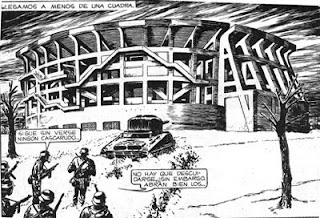
River were founded in the neighbourhood of Boca by the workers of the Wilson coalyard, who had decided to form a football team. The name was taken from the containers which were shipped in and out of the coalyard on a daily basis, and they eventually merged with La Rosales to found the club as it is known today. The early years of amateur football in Argentina were dominated by British workers in the form of Alumni, made up of students of the Buenos Aires English High School. When they disbanded in 1911, it was Racing who took up the mantle, winning seven consecutive championship titles. It wasn't until the arrival of full professionalism in the 1930s when River began to shine, and also garnered their nickname millonarios or millionaires. With the expensive signings of Carlos Peucelle and Bernabé Ferreyra, River Plate were to change the history of Argentine football. Ferreyra's fee was around £23,000 at the time, which works out at around £6-8 million in today's money2. He turned out to be worth every penny, scoring 43 goals in 34 games in the 1932 season, and finished his career with more goals scored than games played. In that same year, they finished level on top with Independiente, and won the playoff 3-0, claiming their first professional championship. In 1938, another historic moment in River's history took place, as they moved to El Monumental stadium, which has become an iconic image in Argentine culture, even appearing in the famous graphic novel by Hector Germán Oesterheld El Eternauta.
The scenes after last night's relegation were as apocalyptic for River fans as Oesterheld's vision from 1957, and the aftermath had the air of life imitating art, as can be seen in Olé's coverage of the events3.

From its inauguration on 26th of May that year, el Monumental was to be home to a constant flow of success for River. By the 1940s, River had constructed a team of renown, still remembered to this day: La Máquina. Juan Carlos Muñoz, Adolfo Pedernera, D'Alessandro, Ángel Labruna (who still sits atop the all time goalscoring charts in the Argentine league), Félix Loustau and Aristóbulo Deambrossi were some of the players who formed that historic team, famed for their passing and movement which caused defenders nightmares, and who form a large part of the mythical history of the Buenos Aires club. The title in 1942 was claimed in La Bombonera, as sweet a victory as River could ask for, coming back from two goals down to claim the title against their arch rival. 1947 was another year which stood out, with Alfredo Di Stéfano leading an attack which scored 90 goals in a mere 30 matches, and the legendary goalkeeper Amadeo Carrizo leading a defence which helped River win another title. That level of success continued into the 1950s, even with players moving to European giants and to Columbia, where a burgeoning league was able to pay high wages. River won 6 titles in that decade, as well as winning their first tricampeonato between 1955-57. in 1958, River also had 9 players in the national team's Starting XI, a record of representatives for one club.

River's success dried up shortly afterwards, and for 18 years they went without silverware, a period which, until Sunday, would have marked their lowest ebb. In 1968 they came close, but were denied by the hand of Luis Gallo of Vélez, who blocked the ball of his line with minutes remaining. River were not to win again until the 1970s, and once again Ángel Labruna was the saviour of Los Millonarios, this time, however, as coach.
The emergence of more stars in River's illustrious history was to help them to a renewed period of success under his stewardship, with Norberto “Beto” Alonso and Ulbaldo Filiol leading the team, and players such as current manager Juan José “J. J.” López and current president Daniel Pasarella coming through the youth ranks to become titulares. Between 1975-79, River won four Metropolitanos and two Nacional tournaments, including doing the double in 1975 and again in 1979.

In 1983, the signing of Enzo Francescoli began a process of rejuvination which was to bring about arguably the greatest period in the history of River. By 1985, River were champions again, losing only three games on their way to the 1985/86 league title. The return of Alonso (who was sold to Vélez after a falling out with the legendary Alfredo Di Stéfano, who had been manager until '82) and the addition of Oscar Ruggeri, amongst others, led the team to their first Copa Libertadores glory, although Francescoli had left for France before the victory in 1986. That same year, River also won the Intercontinental Cup. It would be ten years before the club won the Libertadores again in 1996, this time, however, Francescoli was present (along with other famous names such as Hernán Crespo, Ariel Ortega and Juan Pablo Sorín) to help the club regain its place as the leader on the continent. River continued to win titles into the 2000s, yet the dip in form which has led to relegation began in 2008, when River finished last in the table. Managerial instability, debt problems left by the presidency of José María Aguilar to the tune of $140 million and overall instiutional difficulties have culminated in the relegation of one of the world's most historic and famous clubs.

As Veléz winning the title was overshadowed by Martín Palermo's retirement at Boca, so Córdoba's promotion has also been left aside somewhat in the tumult of events since the game was abandoned. They were deserved winners over two legs, and eventually analysis will turn to their performances and their newly-attained top flight status. The worry for fans of Argentine football is twofold however. Firstly, the seemingly endemic fan violence in the game which reared its ugly head yesterday has seen Argentina's reputation tarnished just before they host the Copa América. It should be noted that this violence is part of the club game, and doesn't spill into the international arena. The Copa América will take place in safe environments, and will be undisturbed by scenes anything like those witnessed at El Monumental. However for the benefit of the sport at the club level, this is something which should be addressed. Secondly, the biggest game of the Argentine calendar, the meeting of two old local rivals which has taken place since 1913, will be missing: The superclásico. Without it, the league will feel somewhat more empty (as will a few people's pockets), and although many Boca fans are probably smiling at the embarrassment of their neighbours, they will certainly miss the high and the excitement of a match which pits two giants of world football against one another. The instiutional and economic problems of the club reach back beyond this season, and unless these issues are resolved, it will be difficult for River to return to the top flight quickly.


Garrincha: The Last of the Factory Footballers


In few, if any other countries, is a love of football so strongly linked to the national identity than Brazil, where the game's roots are both elite and populist, spreading across all sectors of society. The roots of football in Brazil begin in the late 19th century and just over fifty years later it was so ingrained in the national psyche that the events which led to the loss of the World Cup in 1950 have yet to be erased by multiple subsequent wins of the Jules Rimet and World Cup trophy. To examine Garrincha, perhaps the last and the greatest of the amateur factory or worker footballers turned professional, a man beloved by Brazil as a nation and one who embodied the spirit of the game in the country, I will first look at the Brazil's past and its relationship with football.